
Ready to stop losing leads?
Turn your sound on for the full experience.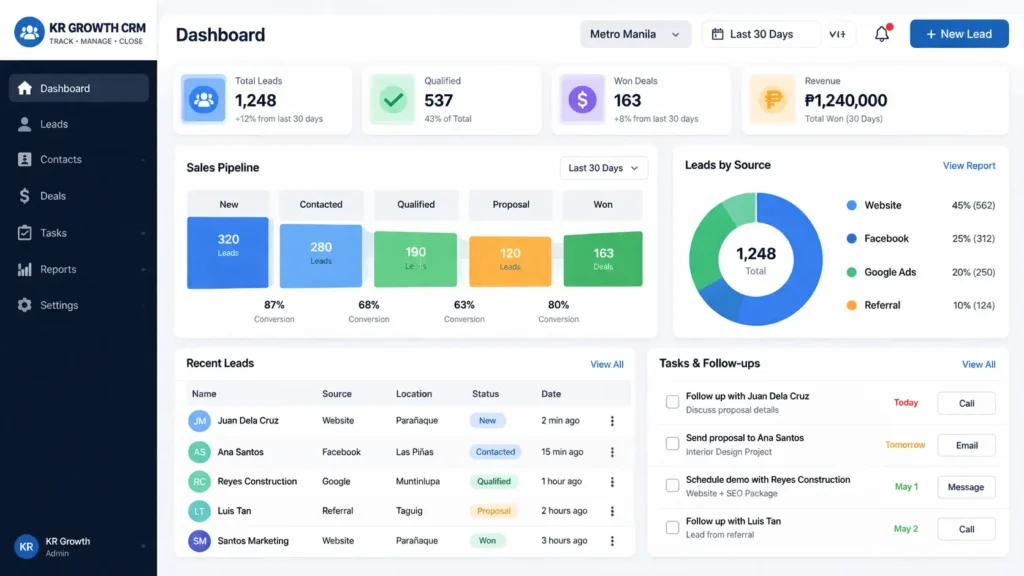
Losing leads in Metro Manila? Fix your CRM and tracking

Quick answer
You are losing leads when inquiries arrive from several channels and nothing records them in one place. Without tracking, you cannot see which channel works. Without a CRM, follow up depends on memory. The fix is one pipeline that captures every inquiry, shows its stage, and prompts the next follow up.
In this article
Key takeaways
- Without tracking, marketing decisions are based on assumptions.
- Speed matters. Slow replies send customers to another business.
- A CRM shows every lead from inquiry to conversion in one view.
- Businesses that manage leads better and respond faster consistently win.
Key terms explained (10)
- Lead
- A person who has shown interest in buying, usually by calling, messaging or filling in a form.
- Inquiry
- A question or request from a potential customer. Every inquiry is a lead until it is answered or lost.
- Channel
- A place inquiries come from, such as your website, Messenger, Instagram, phone calls or referrals.
- CRM
- Customer relationship management software: one place that stores your leads, conversations and deals. Salesforce and GoHighLevel are examples.
- Tracking
- Measuring where your visitors and leads come from and what they do, so decisions are based on data.
- Google Analytics
- Google’s free tool that shows how many people visit your website, where they came from and what they did.
- Sales pipeline
- The stages a lead moves through, from first inquiry to paying client, shown in one view.
- Follow up
- Any contact after the first reply: a second message, a reminder or a call.
- Automation
- Software doing a repeated task for you, such as sending a reply or a reminder at a set time.
- Conversion
- When a lead takes the action you want, such as booking or paying.
Why am I losing leads I already have?
If you are not tracking your leads, you are losing clients.
If you run a business in Metro Manila, especially in cities like Parañaque, Las Piñas, Muntinlupa, or Taguig, you are likely getting inquiries from different channels. These may come from your website, social media, or referrals.
However, without a proper system, many of these leads are lost or ignored. As a result, you miss opportunities that could have turned into paying clients.
Swipe sideways to see the whole sketch.
Businesses must adapt to digital systems to stay competitive. This includes how you track and manage leads.
What should a simple sales pipeline look like?
A CRM allows you to track every lead from inquiry to conversion. You can clearly see which leads are new, which need follow up, and which are ready to close.
Four stages. Nothing forgotten.
What to record at each stage so no lead depends on memory.
Name, contact, what they asked, and the channel it came from.
Who replied, when, and what was said.
The next action and the date it is due.
What they bought, and where the lead first came from.
This gives you control over your pipeline instead of relying on memory or scattered messages.
What are the signs my leads are leaking?
1You don’t know where your leads are coming from
Guessing leads to poor decisions. Without tracking, you cannot clearly identify what is working in your marketing:
- Which channel brings in inquiries
- Which pages generate leads
- Which location drives the most traffic
Tools like Google Analytics allow you to see where your visitors come from and how they behave on your website. Without this data, you are making decisions based on assumptions.
2Your follow up process is inconsistent
Leads go cold quickly. In competitive areas like Metro Manila, speed matters. If you do not respond quickly, potential clients choose another business. Without a CRM system, leads are often forgotten, delayed and unorganized.
Platforms like Salesforce and GoHighLevel help businesses organize leads, track follow ups, and manage communication effectively.
3You have no clear sales pipeline
No system means no growth. If you cannot say how many leads are waiting for a reply right now, you do not have a pipeline. You have an inbox.
| What you need | Spreadsheet and inbox | CRM with tracking |
|---|---|---|
| Every inquiry captured | Only if someone types it in | Captured automatically from each channel |
| Knowing where a lead came from | Usually a guess | Recorded with every lead |
| Follow up on time | Depends on memory | Reminders and automation |
| Seeing the whole pipeline | Scattered across chats and sheets | One view, by stage |
| Working as you grow | Breaks with more people and channels | Scales with your team |
Swipe the table sideways to see every column.
We will map where your inquiries land and show you where they go cold.
Get my free diagnosisHow much are lost leads costing me?
Move the sliders to match your own business. The numbers shown at the start are only an example.
Lost lead estimator
Uses your numbers, not ours.
A simple estimate: inquiries × missed share × buy rate × average sale. Your real figures will differ.
Why are organized competitors winning?
Structure beats guesswork. Businesses in Parañaque, Las Piñas, Muntinlupa, and Taguig are competing for the same clients. Those who manage leads better and respond faster consistently win. CRM and tracking give you that advantage.
How do I set up CRM and tracking?
- List every channel inquiries come from. Website forms, Messenger, Instagram, calls and referrals.
- Install tracking on your website. So you can see which pages and channels bring in leads.
- Build one pipeline with clear stages. New inquiry, contacted, follow up, won.
- Set follow up rules and automation. Decide how fast every inquiry gets a reply and what happens next.
- Review the numbers every week. Keep what works and fix where leads go quiet.
How do I turn my leads into a system?
Your business should not depend on luck or memory. With proper tracking and CRM, you can understand your leads, improve your follow up, and convert more clients consistently.
We help businesses set up CRM and tracking systems tailored to how they actually get leads. This includes proper tracking, pipeline setup, and automation so no opportunity is missed. See our lead capture and CRM service and conversion tracking service. If the leads are not arriving in the first place, check why your business may be invisible on Google.

Frequently asked questions
What is a CRM in simple terms?
A CRM, or customer relationship management system, is one place that stores every lead and customer, shows what stage each one is at, and reminds your team what to do next.
Do small businesses need a CRM?
If inquiries reach you through more than one channel, or more than one person replies to them, yes. That is the point where memory and spreadsheets start losing leads.
What is the difference between tracking and a CRM?
Tracking shows where visitors and leads come from and what they do on your website. A CRM manages what happens after they inquire. You need both to see the full path from first click to paying client.
Which CRM should I use?
It depends on how you get leads and how your team works. Platforms like Salesforce and GoHighLevel are common choices. The best CRM is the one your team will actually use every day.
Keep reading
More growth insights
Actionable strategies to get found on Google and AI, and stop losing leads.
Google Business Profile Not Getting Calls? Here’s Why
Your Google Business Profile gets views but no calls because of conversion, not visibility. See the five reasons, a fix table and a one minute profile check.

Why Your Business Is Invisible on Google in Metro Manila
Your business is invisible on Google when Google cannot connect it to a service and a location. Learn the three ranking factors and the five fixes for Metro Manila.
Stop losing leads
We set up CRM and tracking tailored to how you actually get leads, so no opportunity is missed.